





I was reading a recent Gartner report on technology trends for 2026, and one prediction in particular caught my attention: they warn of the risk of an *“atrophy of critical thinking”* within companies. The reason? The use of automation and systems that lead professionals to accept automated answers without questioning or understanding the process.
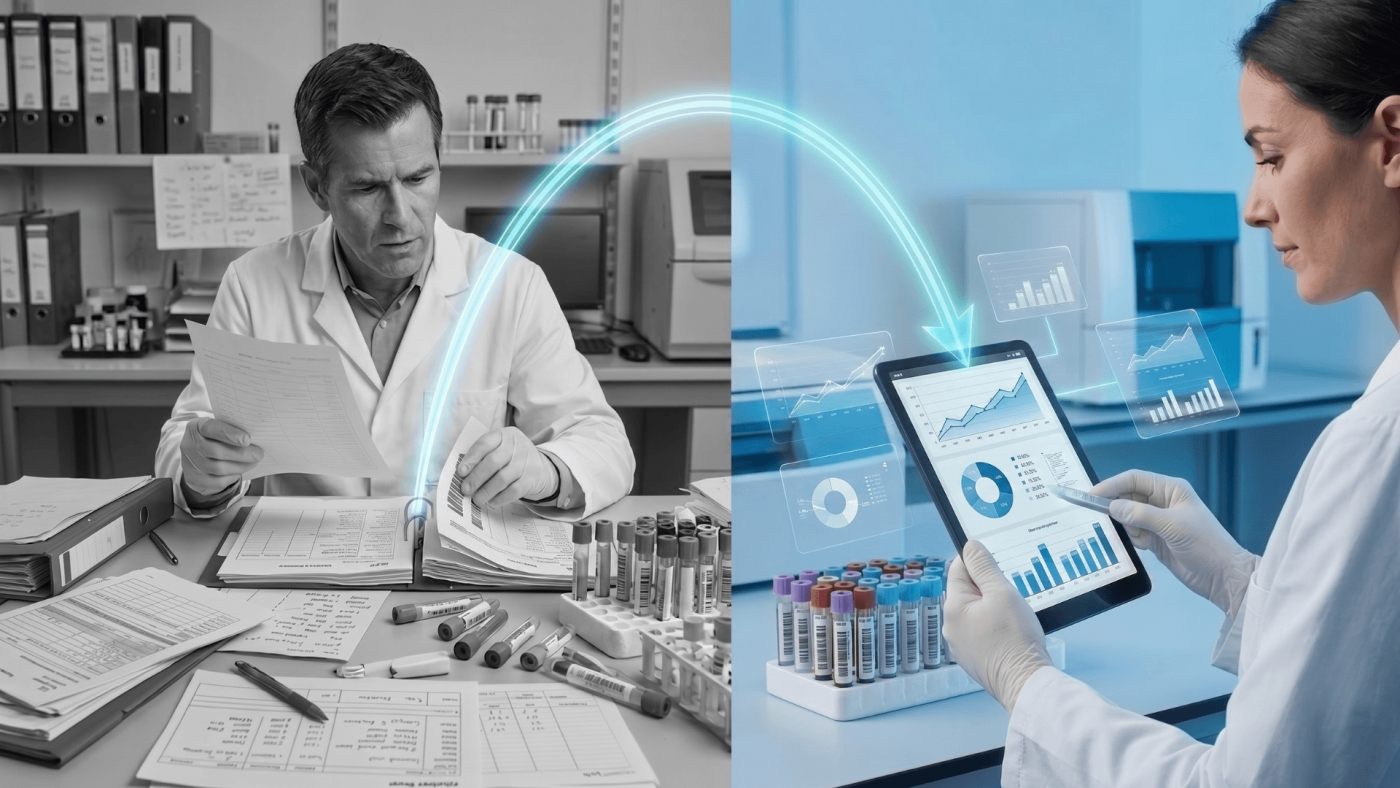
The takeaway is thought-provoking: when technology is poorly implemented, it breeds complacency. But when it is well-designed, it does the opposite: it frees the human mind for what truly matters.
In the laboratory, we experience this duality every day during the pre-analytical phase.
Automation isn't “turning off your brain.”
If your traceability system serves merely as a “tube scanner” that adds no intelligence to the process, you are falling into this trap. Healthcare technology should not exist to replace the judgment of the collection professional, but rather to eliminate operational overload.
A collector or manager who has to expend mental energy memorizing dozens of manual workflow rules, checking paper lists, and reviewing spreadsheets becomes exhausted. It is exhaustion—not a lack of competence—that leads to errors in the pre-analytical phase.
Technology as a support for reasoning
At eTrack, our philosophy has always been to build assistive technology. The system acts as an invisible safety net that handles the administrative workload, allowing the professional to focus on decision-making and the quality of care:
- Less Operational Noise: The system validates batch rules, schedules and tube types in real time. The professional does not need to “guess” or memorize exceptions; the system warns.
- Decisão Baseada em Dados Confiáveis: The manager wastes no time trying to figure out where a non-conformity originated. The dashboard provides a clear, traceable process map.
- Valuing the Human Factor: When the tool handles repetitive checks, the team has time to apply empathy to patient care and technical rigor to sample collection.
Smart technology empowers people.
As I always say, technology is just one of the pillars. It only delivers real value when it serves to empower people and safeguard processes.
A good tool isn't one that stops the team from thinking, but one that eliminates manual, repetitive work, allowing the team to work with greater precision, safety, and intelligence.
To read the full analysis on technology and behavior trends for 2026, click here. It is worth reflecting on for those who lead teams in the healthcare sector.
Leonardo Lippel Rodrigues
Sales and Technology Manager